Shared effort without shared pace
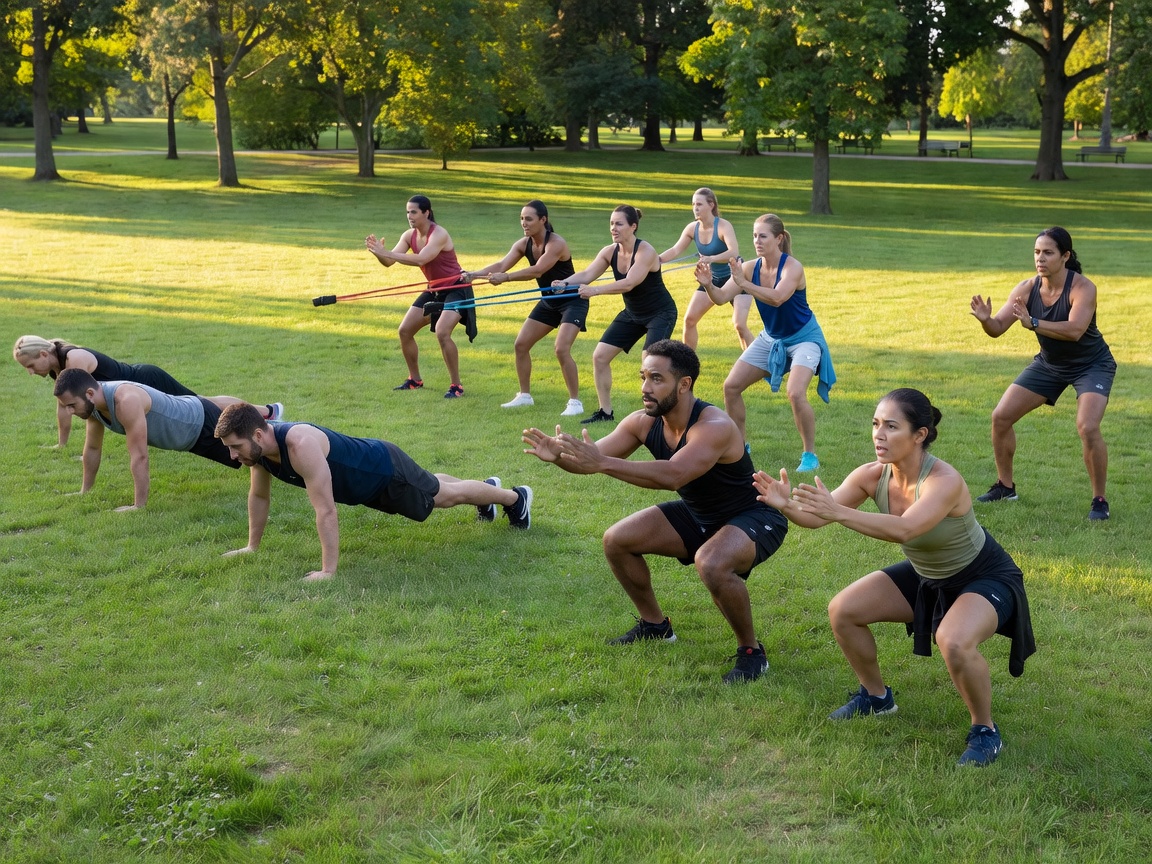
Group training has a reputation for being loud and competitive. The formats that last tend to be the opposite: everyone does the same work at a personal intensity, and the group supplies rhythm rather than a scoreboard. Circuits, open-air sessions and volunteering runs all follow that pattern.
Where circuits come from
Circuit training was developed at the University of Leeds in 1953 by R. E. Morgan and G. T. Adamson. The idea was simple: arrange a series of exercises as stations and move around them in turn. Each station works a different part of the body, so no single muscle group tires before the rest.
The same design explains why circuits suit groups. Everyone is at a station at the same moment, yet the effort is personal, because each person chooses how hard to work at it.
How stations let different levels share a space
Good group sessions build in options. A station might offer a lighter, a standard and a harder version of the same movement, and the leader expects people to pick one and change it mid-session.
Time-based work helps too. When stations run for a set time rather than a set number of repetitions, a slower person is not left behind and a faster one is not left waiting.
Terms you will hear
- Station
- One exercise position within a circuit.
- Interval
- A block of effort followed by a block of rest.
- Scaling
- Changing a movement to make it easier or harder for you.
- Tabata
- A format of 20 seconds of work and 10 seconds of rest repeated for eight rounds, four minutes in total, drawn from research by Izumi Tabata. The intensity is relative to the person doing it.
November Project: free sessions in public spaces
November Project began in Boston in 2011, started by Brogan Graham and Bojan Mandaric as a free early-morning workout that anyone could join. Its sessions use public spaces such as stadium steps, hills, parks and bridges, and the pitch is simple: turn up and the group does the rest. Cost is not a barrier, and nobody signs a contract.
Early sessions famously used the stands of Harvard Stadium. The idea spread to other cities, each local group running its own schedule, so whether one exists near you is something to check, not assume. Expect a lively, welcoming mood, and remember nobody is timing you against the person next to you.
GoodGym: running with a purpose
GoodGym began in London in 2008 and links running with practical help for others. Runners head to a task, such as a community project or a visit to an older neighbour, and run back. The purpose does the motivating.
For people who find a plain workout hard to justify, a reason outside themselves can be the difference between going out and staying in. Groups are local, so check the organisation's own information for what exists in your area.
Questions to ask before a first session
- How are exercises adapted for beginners?
- Can I stop and rest whenever I need to?
- Is there a warm-up and a cool-down?
- What happens in bad weather, and is there an indoor fallback?
- Where do we meet, and who should I ask for?
This is general information, not personal advice. If you have a health condition, are pregnant, are recovering from injury or have been inactive for a long time, talk to a doctor or another qualified professional before starting hard group training.